Vocabulary: Batch 63

#6201 to #6300 (100 entries)

#6300

barrage

barrage /bəˈrɑːʒ/ countable noun

From French, originally military. "Barrage" the structure (dam) is stressed on the first syllable in British English: /ˈbærɑːʒ/.

  1. a continuous attack with heavy artillery fire

    The town was destroyed by an artillery barrage.

  2. an overwhelming quantity or onslaught of something (questions, complaints, etc.)

    She faced a barrage of questions from reporters.

#6299

tablecloth

tablecloth
tablecloth
tablecloth /ˈteɪbəlklɔːθ/ countable noun
  • a cloth used to cover a table, especially during a meal

    She spread a white tablecloth over the dining table.

#6298

calamari

calamari
calamari
calamari /ˌkæləˈmɑːri/ uncountable noun food

From Italian, meaning "squid". Often refers specifically to deep-fried squid rings.

  • squid prepared as food, typically sliced into rings and fried

    We ordered calamari as an appetizer.

#6297

feta

feta
feta
feta /ˈfetə/ uncountable noun

Protected designation of origin (PDO): only cheese made in Greece can legally be called "feta" in the EU.

  • a salty, white Greek cheese made from sheep's or goat's milk, with a crumbly texture

    The Greek salad was topped with crumbled feta.

#6296

fava bean

fava bean
fava bean
fava bean /ˈfɑːvə biːn/ countable noun vegetable

"Fava" is the American name (from Italian fava); British English uses "broad bean". Famously referenced in the movie "The Silence of the Lambs".

  • a large flat edible bean (also called broad bean) from a plant of the pea family

    He served the lamb with fava beans and a nice chianti.

#6295

tapas

tapas
tapas
tapas /ˈtɑːpəs/ plural noun

From Spanish. Singular "tapa" is rare in English; usually treated as plural-only. From Spanish tapar ("to cover") because small plates were originally laid on top of drinks to keep flies away.

  • small Spanish savory dishes, typically served as a snack with drinks

    We shared a few tapas at a bar in Madrid.

#6294

medley

medley /ˈmedli/ countable noun
  1. a varied mixture of people or things

    The garden was a medley of colors and scents.

  2. a piece of music made up of several different tunes played one after another

    The band played a medley of Beatles songs.

  3. a swimming race in which competitors use a different stroke for each segment

    She won gold in the 400m individual medley.

#6293

mouth-watering

mouth-watering /ˈmaʊθwɔːtɚɪŋ/ adjective
  • (of food) looking or smelling so delicious that it makes one's mouth water

    The bakery window was full of mouth-watering pastries.

#6292

fringe

fringe /frɪndʒ/ countable noun

British English: "fringe" can also mean bangs (the hair cut across the forehead). "Fringe benefits" = extra perks of a job. "Fringe theory" = an unorthodox view held by a minority.

  1. a decorative border of hanging threads, cords, or strips on a piece of cloth

    The shawl had a long silk fringe.

  2. the outer or marginal part of an area, group, or sphere of activity

    He lives on the fringe of the city.

#6291

submerge [family]

submerge /səbˈmɝdʒ/ verb
past: submerged /səbˈmɝdʒd/
pp: submerged /səbˈmɝdʒd/
  1. to push or cause to be below the surface of water

    The submarine submerged silently.

  2. (figurative) to completely hide or absorb something

    She submerged herself in her work to forget her grief.

submerged /səbˈmɝdʒd/ adjective
  • under the surface of water or another liquid

    The submerged rocks were hard to see.

submersible /səbˈmɝsəbəl/ adjective
  • able to operate underwater

    The team used a submersible camera.

submersible /səbˈmɝsəbəl/ countable noun
  • a small vehicle designed to travel underwater

    The submersible reached the shipwreck.

submersion /səbˈmɝʒən/ uncountable noun
  • the action of submerging or the state of being submerged

    Prolonged submersion in water can damage the device.

#6290

crater [family]

crater
crater
crater /ˈkreɪtɚ/ countable noun
  1. a large bowl-shaped hole in the ground or on the surface of a planet, made by an explosion or impact

    The asteroid left a massive crater in the Arizona desert.

  2. the mouth of a volcano

    Smoke rose from the crater of the volcano.

cratered /ˈkreɪtɚd/ adjective
  • marked or filled with craters

    The cratered surface of the moon is visible through the telescope.

#6289

trample

trample /ˈtræmpəl/ verb
past: trampled /ˈtræmpəld/
pp: trampled /ˈtræmpəld/

Common figurative phrase: "trample on someone's rights" = violate or disregard them.

  1. to step heavily on something or someone, causing damage

    The crowd trampled the flower beds in their rush to leave.

  2. (figurative) to treat with cruel disregard

    The new law tramples on workers' rights.

#6288

idyllic [family]

idyllic /aɪˈdɪlɪk/ adjective
  • extremely happy, peaceful, and picturesque

    They spent an idyllic week on the island.

idyll /ˈaɪdəl/ countable noun
  • a scene or event of a peaceful, idyllic nature

    Their weekend in the countryside was a pastoral idyll.

#6287

stark

stark /stɑːrk/ adjective

"Stark naked" = completely naked. "Stark contrast" = striking, obvious contrast.

  1. severe or bare in appearance or outline

    The trees stood stark against the winter sky.

  2. unpleasantly or sharply clear; harsh

    There is a stark contrast between rich and poor in this city.

#6286

monastery [family]

monastery
monastery
monastery /ˈmɑːnəsteri/ countable noun

The female equivalent is a "convent" or "nunnery".

  • a building or community in which monks live under religious vows

    The monks have lived at this monastery for centuries.

monastic /məˈnæstɪk/ adjective
  1. relating to monks, nuns, or their way of life

    He chose a monastic life of prayer and silence.

  2. (figurative) resembling the strict, simple life of monks

    She lived a monastic existence focused only on her research.

#6285

revere [family]

revere /rɪˈvɪr/ transitive verb
past: revered /rɪˈvɪrd/
pp: revered /rɪˈvɪrd/

Formal. Often used in passive: "is revered for...".

  • to feel deep respect or admiration for someone or something

    He is revered as one of the greatest scientists of all time.

reverence /ˈrevɚəns/ uncountable noun

Related: reverent (adj.), reverently (adv.). "The Reverend" (Rev.) : title for clergy.

  • deep respect for someone or something

    He spoke about her with great reverence.

reverent /ˈrevɚənt/ adjective
  • feeling or showing deep respect

    He bowed his head in a reverent silence.

reverently /ˈrevɚəntli/ adverb
  • in a way that shows deep respect

    She reverently placed the flowers on the grave.

#6284

fling [family]

fling /flɪŋ/ transitive verb
past: flung /flʌŋ/
pp: flung /flʌŋ/
  1. to throw or hurl with force

    She flung her keys onto the table.

  2. to move oneself or part of one's body suddenly and energetically

    He flung himself onto the sofa.

fling /flɪŋ/ countable noun
  1. a short, casual sexual or romantic relationship

    They had a brief fling during the summer.

  2. a short period of enjoyment or wild behavior

    After graduation, she had one last fling before starting work.

#6283

chic

chic /ʃiːk/ adjective

From French. Note the pronunciation: "sheek", not "chick".

  • elegantly and stylishly fashionable

    She wore a chic black dress to the gala.

chic /ʃiːk/ uncountable noun
  • stylishness and elegance, typically of a particular kind

    The boutique offered Parisian chic at New York prices.

#6282

rickety

rickety /ˈrɪkəti/ adjective
  • (of a structure or piece of furniture) poorly made and likely to collapse

    They climbed the rickety wooden staircase to the attic.

#6281

tavern

tavern
tavern
tavern /ˈtævɚn/ countable noun

Old-fashioned/literary; in modern American usage, "bar" or "pub" is more common.

  • an establishment for the sale of beer and other drinks, and sometimes also food, to be consumed on the premises

    The travelers stopped at a roadside tavern for the night.

#6280

ruin [family]

ruin /ˈruːɪn/ transitive verb
past: ruined /ˈruːɪnd/
pp: ruined /ˈruːɪnd/
  1. to damage or spoil something completely

    The rain ruined our picnic.

  2. to cause someone to lose all their money or position

    The investment scandal ruined him financially.

ruin /ˈruːɪn/ noun
  1. (uncountable) the state of being destroyed; complete destruction

    The earthquake reduced the city to ruin.

  2. (countable, often plural) the remains of a destroyed or decayed building

    We visited the ruins of the ancient temple.

ruinous /ˈruːənəs/ adjective
  • causing or likely to cause ruin; disastrous

    The company took on ruinous levels of debt.

#6279

teem

teem /tiːm/ intransitive verb
past: teemed /tiːmd/
pp: teemed /tiːmd/

Always intransitive; typically used in the form "teem with".

  • to be present in large numbers; to be full of (typically people or animals)

    The river was teeming with fish.

#6278

citadel

citadel /ˈsɪtədəl/ countable noun
  1. a fortress that protects or dominates a city

    The citadel stood on a hill overlooking the harbor.

  2. (figurative) a stronghold or center of something

    The university is a citadel of free thought.

#6277

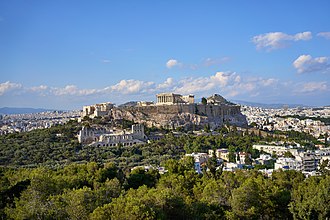
Acropolis

Acropolis
Acropolis
Acropolis /əˈkrɑːpəlɪs/ proper noun

From Greek akros ("highest") + polis ("city"). The Athenian Acropolis with the Parthenon is the most famous; the term applies to similar citadel sites in other ancient Greek cities too.

  • the fortified high part of an ancient Greek city, especially the citadel of Athens crowned by the Parthenon

    They climbed the steep path up to the Acropolis at sunset.

#6276

tunic

tunic
tunic
tunic /ˈtuːnɪk/ countable noun
  1. a loose, sleeveless or short-sleeved garment, typically reaching to the thighs or knees, worn in ancient Greece and Rome

    The statue showed a soldier in a tunic and sandals.

  2. a close-fitting short jacket worn as part of a uniform

    The officer's tunic was decorated with medals.

#6275

cradle

cradle /ˈkreɪdəl/ countable noun

"The cradle of civilization" is a phrase often used for Mesopotamia.

  1. a small bed for a baby that can be rocked

    The baby slept peacefully in the cradle.

  2. (figurative) the place or period in which something originates

    Greece is often called the cradle of Western philosophy.

cradle /ˈkreɪdəl/ transitive verb
past: cradled /ˈkreɪdəld/
pp: cradled /ˈkreɪdəld/
  • to hold gently and protectively, as if in a cradle

    She cradled the kitten in her arms.

#6274

shutter [family]

shutter
shutter
shutter /ˈʃʌtɚ/ countable noun
  1. a hinged panel, often louvered, fitted to a window for protection or privacy

    They closed the shutters before the storm.

  2. the part of a camera that opens to expose the film or sensor to light

    He set the shutter speed to 1/500.

shuttered /ˈʃʌtɚd/ adjective

From shutter (the window covering). "Shuttered business" = a closed-down business.

  • having shutters covering the windows; closed

    They walked past the shuttered shops on the empty street.

#6273

whitewash

whitewash /ˈwaɪtwɑːʃ/ verb
past: whitewashed /ˈwaɪtwɑːʃt/
pp: whitewashed /ˈwaɪtwɑːʃt/
  • to paint a surface with a white lime mixture; (figurative) to cover up or conceal wrongdoing

    The report was a whitewash designed to protect the executives.

whitewash /ˈwaɪtwɑːʃ/ noun
  • a white lime mixture used as cheap paint; (figurative) an attempt to hide unpleasant facts

    Critics called the investigation a whitewash.

#6272

slip [family]

slip /slɪp/ verb
past: slipped /slɪpt/
pp: slipped /slɪpt/

"Slip up" = make a small mistake. "Slip my mind" = forget. "Slip into" = put on clothes quickly.

  1. to slide and lose one's balance or footing

    She slipped on the icy sidewalk.

  2. to move quickly and quietly so as not to be noticed

    He slipped out of the meeting unnoticed.

  3. to put or pass something somewhere with a quick, easy movement

    She slipped the note into his pocket.

slip /slɪp/ countable noun
  1. a small mistake; a minor error

    It was just a slip of the tongue.

  2. a small piece of paper

    She handed me a slip with the address on it.

slippage /ˈslɪpɪdʒ/ noun
  • the action or process of slipping or sliding; failure to meet a standard or deadline

    There has been some slippage in the project's timeline.

slippery /ˈslɪpɚi/ adjective

"Slippery slope" = a course of action that leads inexorably to worse consequences.

  1. difficult to hold firmly or stand on because smooth, wet, or slimy

    The road was slippery after the rain.

  2. (of a person) evasive and unpredictable

    Don't trust him - he's a slippery character.

#6271

coaster

coaster /ˈkoʊstɚ/ countable noun

Also short for "roller coaster" (the amusement park ride).

  • a small mat or disc placed under a glass to protect the surface beneath from drips or heat

    Use a coaster so you don't leave a ring on the table.

#6270

vibrant [family]

vibrant /ˈvaɪbrənt/ adjective
  1. full of energy, life, and excitement

    Barcelona is a vibrant city full of culture.

  2. (of color or sound) bright and striking

    She wore a dress in vibrant red.

vibrancy /ˈvaɪbrənsi/ uncountable noun
  • the quality of being full of energy, life, and excitement

    The market square is known for its vibrancy.

#6269

recess [family]

recess /ˈriːses/ noun

In British schools, the equivalent term is "break" or "playtime".

  1. (American) a short break between school classes; (more generally) a pause in business or proceedings

    The students ran outside during recess.

  2. (countable) a small space set back or hollowed out from a wall or surface; a niche

    The statue stood in a recess in the wall.

recessed /rɪˈsest/ adjective

"Recessed lighting": popular interior design feature where lights are sunk into the ceiling.

  • set back from the surrounding surface

    The kitchen has recessed lighting.

recession /rɪˈseʃən/ countable noun

Technical definition: two consecutive quarters of negative GDP growth. Famous: Great Recession (2007-09), the worst since the Great Depression.

  • a period of temporary economic decline

    The country entered a recession last year.

recessionary /rɪˈseʃəneri/ adjective
  • relating to or causing a recession

    Economists fear recessionary pressures.

recessive /rɪˈsesɪv/ adjective

In genetics, contrasted with "dominant". Both parents must carry a recessive gene for it to be expressed in offspring. Example: blue eyes are recessive.

  • (genetics) of a trait expressed only when both genes are recessive

    Blue eyes are a recessive trait.

#6268

coalition [family]

coalition /ˌkoʊəˈlɪʃən/ countable noun
  • a temporary alliance formed for combined action, especially of political parties forming a government

    The two parties formed a coalition government.

coalesce /ˌkoʊəˈles/ intransitive verb
past: coalesced /ˌkoʊəˈlest/
pp: coalesced /ˌkoʊəˈlest/

From the same Latin root as coalition, coalescere ("to grow together").

  • to come together to form one whole

    The various protest groups coalesced into a single movement.

#6267

compatriot

compatriot /kəmˈpeɪtriət/ countable noun
  • a person from the same country as someone else

    She met some compatriots while traveling abroad.

#6266

shebang

shebang /ʃəˈbæŋ/ countable noun

Almost always used in the phrase "the whole shebang". In computing, "shebang" also refers to the `#!` characters at the start of a script.

  • (informal, in the phrase "the whole shebang") the whole thing; everything

    The buffet included appetizers, mains, desserts, drinks - the whole shebang.

#6265

excruciating

excruciating /ɪkˈskruːʃieɪtɪŋ/ adjective

From Latin excruciare ("to torment"), from crux ("cross"): the original sense was the agony of crucifixion.

  1. intensely painful

    The pain in her back was excruciating.

  2. unbearably embarrassing or tedious

    The meeting was excruciating in its dullness.

#6264

consequent [family]

consequent /ˈkɑːnsəkwənt/ adjective

Formal. Don't confuse with "consequential" (which has a separate sense).

  • following as a result or effect

    The flood and consequent damage forced the town to evacuate.

consequential /ˌkɑːnsəˈkwenʃəl/ adjective
  1. having important and far-reaching effects; significant

    It was the most consequential election in decades.

  2. following as a consequence or result

    The flood and consequential damage cost millions.

#6263

ephemera [family]

ephemera /ɪˈfemɚə/ plural noun

From Greek ephemeros ("lasting only a day"). The singular "ephemeron" is rarely used.

  • things that exist or are used for only a short time, especially printed matter such as tickets, posters, or postcards

    The museum displays vintage ephemera from the 1920s.

ephemeral /ɪˈfemɚəl/ adjective
  • lasting for a very short time

    The beauty of cherry blossoms is famously ephemeral.

#6262

actuate [family]

actuate /ˈæktʃueɪt/ transitive verb
past: actuated /ˈæktʃueɪtɪd/
pp: actuated /ˈæktʃueɪtɪd/

Technical/formal. Common in engineering contexts ("actuator" = the mechanism).

  1. to cause a machine or device to operate

    The motion sensor actuates the alarm.

  2. (formal) to motivate someone to act in a particular way

    She was actuated by a strong sense of duty.

actuator /ˈæktʃueɪtɚ/ countable noun
  • a mechanism that puts something into automatic action, especially by converting a signal into mechanical motion

    A hydraulic actuator opens the valve.

#6261

susceptible [family]

susceptible /səˈseptəbəl/ adjective

Often followed by "to".

  1. likely to be affected by something, especially a disease, condition, or influence

    Young children are particularly susceptible to colds.

  2. easily influenced or affected emotionally

    She is very susceptible to flattery.

susceptibility /səˌseptəˈbɪləti/ uncountable noun
  • the state of being likely to be affected by something

    Age increases susceptibility to certain diseases.

#6260

foliage

foliage /ˈfoʊliɪdʒ/ uncountable noun

"Fall foliage" refers to the colored leaves of autumn, a famous tourist attraction in New England.

  • the leaves of a plant or tree collectively

    The dense foliage hid the small cottage from view.

#6259

produce [family]

produce /prəˈduːs/ transitive verb
past: produced /prəˈduːst/
pp: produced /prəˈduːst/

Verb is stressed on the second syllable; noun on the first. Common stress-shift pattern in English.

  1. to make or manufacture from raw materials

    The factory produces 10,000 cars per year.

  2. to bring something into existence; to create or yield

    His research produced surprising results.

  3. to show or present for examination

    He produced his passport at the border.

produce /ˈproʊduːs/ uncountable noun
  • fresh fruits and vegetables, especially as sold in a store

    The produce section is at the front of the supermarket.

producer /prəˈduːsɚ/ countable noun

In film/TV/music, the producer manages the production process (distinct from the director, who handles creative decisions).

  • a person or company that produces something

    He is the producer of the show.

product /ˈprɑːdʌkt/ countable noun

"Product manager" (PM): major modern tech job. "Gross domestic product" (GDP): economic measure.

  • a thing that is made or grown for sale

    They launched a new product last month.

production /prəˈdʌkʃən/ noun
  • the action of making or manufacturing

    Production has slowed due to supply issues.

production line /prəˈdʌkʃən laɪn/ countable noun

Pioneered by Henry Ford for the Model T (1913). Also called assembly line.

  • a series of workers and machines in a factory

    He worked on the production line for 20 years.

productive /prəˈdʌktɪv/ adjective

Often used in contrast to "busy": being busy isn't the same as being productive.

  • producing large amounts of goods or results

    It was a very productive meeting.

productivity /ˌproʊdʌkˈtɪvəti/ uncountable noun

Major economic indicator ("productivity growth"). Also: "productivity apps" (todoist, Notion, etc.).

  • the state of being productive; output per unit of input

    The new software improved productivity.

counter-productive /ˌkaʊntɚprəˈdʌktɪv/ adjective

The closed spelling counterproductive is more common.

  • having the opposite of the intended effect

    Arguing harder became counter-productive.

#6258

badger

badger
badger
badger /ˈbædʒɚ/ countable noun animal
  • a stocky burrowing mammal with a black-and-white striped face, found in Europe, Asia, and North America

    A badger lives in a setts under the old oak tree.

badger /ˈbædʒɚ/ transitive verb
past: badgered /ˈbædʒɚd/
pp: badgered /ˈbædʒɚd/

Verb sense comes from the cruel sport of "badger-baiting".

  • to repeatedly and annoyingly ask someone to do something

    The kids badgered their parents for a new puppy.

#6257

ear

ear
ear
ear /ɪr/ countable noun body

Idioms: "play it by ear" = improvise; "have someone's ear" = have their attention; "go in one ear and out the other" = not be listened to. "Ear" of corn = the seed-bearing part of a grain plant.

  • the organ of hearing on either side of the head

    She whispered something in his ear.

ear /ɪr/ countable noun
  • the seed-bearing head of a cereal plant

    He picked an ear of corn from the field.

#6256

bleak

bleak /bliːk/ adjective
  1. (of a situation) not hopeful or encouraging

    The economic outlook is bleak.

  2. (of a place) bare, cold, and exposed to harsh weather

    The bleak moorland stretched for miles.

#6255

bollard

bollard /ˈbɑːlɚd/ countable noun
  1. a short post used to stop or divert vehicles, often used to protect pedestrians or buildings

    They installed bollards along the sidewalk to prevent cars from parking.

  2. a strong post on a ship or quay for securing mooring lines

    The crew tied the rope to the bollard.

#6254

consensus [family]

consensus /kənˈsensəs/ noun

Note: "general consensus" is technically redundant since consensus already implies generality, but the phrase is common.

  • a general agreement among a group of people

    The committee reached a consensus on the new policy.

consensual /kənˈsenʃuəl/ adjective
  • relating to or involving consent, especially mutual consent

    The activity was completely consensual.

#6253

suppress [family]

suppress /səˈpres/ transitive verb
past: suppressed /səˈprest/
pp: suppressed /səˈprest/
  1. to forcibly put an end to (a rebellion, protest, etc.)

    The government suppressed the uprising within days.

  2. to prevent the expression or development of (a thought, feeling, or reaction)

    She tried to suppress a smile.

  3. to prevent the publication or disclosure of (information)

    The report was suppressed for years.

suppressant /səˈpresənt/ countable noun

"Appetite suppressant" is a common diet aid.

  • a drug or other substance that suppresses something

    She took an appetite suppressant.

suppression /səˈpreʃən/ uncountable noun
  • the action of forcibly putting an end to something, or preventing a thought or feeling from being expressed

    The suppression of the free press alarmed human rights groups.

#6252

bread and butter

bread and butter /ˌbred ən ˈbʌtɚ/ noun

Idiomatic: refers to one's main source of livelihood. Also an adjective: "bread-and-butter issues" = basic/everyday concerns.

  1. a person's main source of income; one's livelihood

    Teaching is her bread and butter.

  2. basic and essential, but not exciting

    Customer service is bread-and-butter work for our staff.

#6251

concede [family]

concede /kənˈsiːd/ verb
past: conceded /kənˈsiːdɪd/
pp: conceded /kənˈsiːdɪd/
  1. to admit or acknowledge that something is true after first denying or resisting it

    She finally conceded that he was right.

  2. to acknowledge defeat in an election or contest

    The candidate conceded the race late on election night.

  3. to grant a right, privilege, or territory, especially reluctantly

    The country was forced to concede the disputed islands.

concession /kənˈseʃən/ countable noun
  1. a thing that is granted, especially in response to demands

    The government made several concessions to the protesters.

  2. the right to use land or other property for a specified purpose, granted by a government or company

    The mining concession was sold to a foreign company.

concessionaire /kənˌseʃəˈner/ countable noun
  • the holder of a concession or grant, especially the right to operate a business in a particular location

    The food concessionaire at the stadium operates 20 stands.

concessionary /kənˈseʃəneri/ adjective
  • relating to or involving a concession or reduction in price

    Students receive concessionary tickets.

concessioner /kənˈseʃənɚ/ countable noun

Used especially in US National Parks for licensed operators.

  • a person or company holding a concession to operate a business on government land

    The lodge is run by a National Park concessioner.

#6250

tamper

tamper /ˈtæmpɚ/ intransitive verb
past: tampered /ˈtæmpɚd/
pp: tampered /ˈtæmpɚd/

Always intransitive; used with "with". Connotation is usually negative (interference, sabotage).

  • to interfere with something in a harmful way; to alter without authorization

    Someone tampered with the lock on the back door.

#6249

leaflet

leaflet
leaflet
leaflet /ˈliːflət/ countable noun

Synonym: flyer, pamphlet, handout.

  • a printed sheet of paper containing information or advertising, usually distributed for free

    They handed out leaflets about the upcoming election.

#6248

legion

legion /ˈliːdʒən/ countable noun

Roman legions typically had 4,000-6,000 soldiers.

  1. a large body of soldiers, especially the basic unit of the Roman army

    Caesar marched his legions across the Rubicon.

  2. a vast number of people or things

    She has a legion of fans.

legion /ˈliːdʒən/ adjective
  • great in number

    His mistakes are legion.

#6247

corollary

corollary /ˈkɔːrəleri/ countable noun

Formal/academic. Common in math and philosophy.

  • a direct consequence or result of something already proved or established

    Higher taxes are a corollary of expanded social services.

#6246

hamstring

hamstring /ˈhæmstrɪŋ/ countable noun
  • any of five tendons at the back of a person's knee, or the muscles behind the thigh

    He pulled a hamstring during the sprint.

hamstring /ˈhæmstrɪŋ/ transitive verb
past: hamstrung /ˈhæmstrʌŋ/
pp: hamstrung /ˈhæmstrʌŋ/

Past tense: hamstrung. Originally meant cutting an animal's hamstring tendon to cripple it.

  • to severely restrict the ability or effectiveness of someone or something

    Budget cuts have hamstrung the research program.

#6245

supremacy [family]

supremacy /səˈpreməsi/ uncountable noun
  • the state of being superior to all others in authority, power, or status

    The empire established military supremacy over the region.

supreme /səˈpriːm/ adjective

"Supreme Court" is the highest court in many countries.

  1. highest in rank, authority, or quality

    The Supreme Court made its final ruling.

  2. very great or the greatest

    She made a supreme effort to finish on time.

supremacist /səˈpreməsɪst/ countable noun

Usually used in compounds: "white supremacist", "male supremacist".

  • a person who believes that a particular group, especially a racial or ethnic one, is superior to all others

    The rally was organized by white supremacists.

#6244

refrain

refrain /rɪˈfreɪn/ intransitive verb
past: refrained /rɪˈfreɪnd/
pp: refrained /rɪˈfreɪnd/

Always intransitive; typically "refrain from".

  • to stop oneself from doing something

    Please refrain from smoking inside the building.

refrain /rɪˈfreɪn/ countable noun
  • a repeated line or verse in a song or poem, typically at the end of each stanza; a chorus

    The audience joined in singing the refrain.

#6243

euphoria [family]

euphoria /juːˈfɔːriə/ uncountable noun
  • a feeling or state of intense excitement and happiness

    The team felt a wave of euphoria after winning the championship.

euphoric /juːˈfɔːrɪk/ adjective
  • characterized by or feeling intense excitement and happiness

    She was euphoric about her promotion.

#6242

maritime

maritime /ˈmærətaɪm/ adjective
  1. relating to the sea, especially in connection with shipping, navigation, or naval matters

    The country has a long maritime history.

  2. living or found in or near the sea

    The maritime climate is mild and damp.

#6241

hairline

hairline /ˈhɛrlaɪn/ countable noun

"Hairline fracture" = a very thin crack in a bone. "Receding hairline" = a balding pattern.

  • the edge of a person's hair along the top of the forehead

    His hairline was beginning to recede.

hairline /ˈhɛrlaɪn/ adjective
  • very fine or narrow; thin like a hair

    There was a hairline crack in the windshield.

#6240

jurisprudence

jurisprudence /ˌdʒʊrəsˈpruːdəns/ uncountable noun
  1. the theory or philosophy of law; the study of legal systems

    She specializes in constitutional jurisprudence.

  2. a body of legal decisions or principles

    American jurisprudence has evolved over centuries.

#6239

jurisdiction

jurisdiction /ˌdʒʊrəsˈdɪkʃən/ noun
  1. the official power to make legal decisions and judgments

    The case falls under federal jurisdiction.

  2. the territory or area within which such power can be exercised

    The fugitive fled to another jurisdiction.

#6238

picture [family]

picture /ˈpɪktʃɚ/ countable noun

"Get the picture" (informal) = understand. "Picture yourself..." = imagine.

  1. a visual representation made by painting, drawing, or photography

    She hung a picture of the mountains on the wall.

  2. a movie

    The studio released three pictures last year.

  3. a situation considered as a whole

    The economic picture is improving.

picture /ˈpɪktʃɚ/ transitive verb
past: pictured /ˈpɪktʃɚd/
pp: pictured /ˈpɪktʃɚd/
  1. to imagine or visualize

    Picture yourself on a beach in the Caribbean.

  2. to represent in a picture

    The mural pictures the town's founding.

pictorial /pɪkˈtɔːriəl/ adjective
  • relating to or expressed in pictures; illustrated

    The book includes a pictorial history of the city.

picturesque /ˌpɪktʃəˈresk/ adjective

From picture.

  • visually charming or quaint, as if in a picture

    a picturesque fishing village

#6237

bereaved [family]

bereaved /bɪˈriːvd/ adjective

From archaic verb "bereave" = to deprive (typically of someone through death). Used as adjective or as plural noun "the bereaved".

  • having recently suffered the death of a close relation or friend

    The bereaved family received hundreds of condolence cards.

bereavement /bɪˈriːvmənt/ noun
  • the state of having suffered such a loss; the period of grief that follows

    He took a week off work after the bereavement.

#6236

assay

assay /əˈseɪ/ noun

Common in mining, chemistry, and biology contexts.

  1. the testing of a metal or ore to determine its ingredients and quality

    The gold assay confirmed the purity of the sample.

  2. (general) any test or analysis of a substance

    They ran an assay to measure enzyme activity.

assay /əˈseɪ/ transitive verb
past: assayed /əˈseɪd/
pp: assayed /əˈseɪd/
  • to analyze (a substance) for its composition or properties

    The lab assays soil samples for contamination.

#6235

excrement

excrement /ˈekskrəmənt/ uncountable noun

Formal/clinical term. Other terms include "feces" (medical), "droppings" (animals), "poop" (informal).

  • waste matter discharged from the body, especially feces

    The path was littered with animal excrement.

#6234

bigot [family]

bigot /ˈbɪɡət/ countable noun
  • a person who is intolerantly devoted to their own opinions and prejudiced against others, especially regarding race, religion, or politics

    He was condemned as a bigot for his racist remarks.

bigoted /ˈbɪɡətɪd/ adjective
  • obstinately convinced of the superiority of one's own opinions and prejudiced against those who hold different views

    His bigoted views were not welcome at the meeting.

bigotry /ˈbɪɡətri/ uncountable noun
  • intolerance toward those who hold different opinions; prejudice

    The campaign called for an end to bigotry.

#6233

handful

handful /ˈhændfʊl/ countable noun

"A handful" of someone often describes a difficult or lively child.

  1. the amount that can be held in one hand

    She grabbed a handful of nuts.

  2. a small number of people or things

    Only a handful of guests showed up.

  3. (informal) someone or something difficult to control or manage

    That toddler is a real handful.

#6232

bellwether

bellwether /ˈbelweðɚ/ countable noun

Originally a castrated ram (wether) that wore a bell and led the flock. Common in business and political journalism.

  • a person or thing that indicates a trend; a leading indicator

    This swing state is often a bellwether for the national election.

#6231

incommunicado

incommunicado /ˌɪnkəmjuːnəˈkɑːdoʊ/ adjective

From Spanish. Used both as adjective and adverb.

  • not able, willing, or allowed to communicate with other people

    He went incommunicado for a week to finish his book.

#6230

collude [family]

collude /kəˈluːd/ intransitive verb
past: colluded /kəˈluːdɪd/
pp: colluded /kəˈluːdɪd/

Almost always implies wrongdoing.

  • to come to a secret understanding for a harmful purpose; to conspire

    The two companies colluded to fix prices.

collusion /kəˈluːʒən/ uncountable noun
  • secret or illegal cooperation, especially in order to cheat or deceive others

    There was evidence of collusion between the bidders.

collusive /kəˈluːsɪv/ adjective
  • involving secret or illegal cooperation

    Regulators investigated the collusive behavior of the firms.

#6229

irk [family]

irk /ɝk/ transitive verb
past: irked /ɝkt/
pp: irked /ɝkt/
  • to irritate or annoy

    It irks me when people don't reply to emails.

irksome /ˈɝksəm/ adjective
  • irritating or tedious

    He found the constant interruptions irksome.

#6228

relish

relish /ˈrelɪʃ/ transitive verb
past: relished /ˈrelɪʃt/
pp: relished /ˈrelɪʃt/
  • to greatly enjoy or take pleasure in something

    She relished the chance to travel abroad.

relish /ˈrelɪʃ/ noun

In American food culture, "relish" most often refers to sweet pickle relish for hot dogs.

  1. (uncountable) great enjoyment

    He attacked his meal with relish.

  2. (countable/uncountable) a savory condiment, typically made of chopped pickled vegetables

    He added some relish to his hot dog.

#6227

outburst

outburst /ˈaʊtbɝst/ countable noun
  • a sudden, intense expression of emotion or activity

    She apologized for her angry outburst.

#6226

retribution

retribution /ˌretrəˈbjuːʃən/ uncountable noun

Formal. Often implies justified or divine punishment.

  • punishment inflicted in return for a wrong or crime

    The community sought retribution for the attack.

#6225

straddle

straddle /ˈstrædəl/ transitive verb
past: straddled /ˈstrædəld/
pp: straddled /ˈstrædəld/
  1. to sit or stand with one leg on either side of something

    He straddled the motorcycle.

  2. to extend across or occupy both sides of (a boundary, period, or category)

    The town straddles the border between two states.

#6224

Brunelleschi

Brunelleschi
Brunelleschi
Brunelleschi /ˌbruːnəˈleski/ proper noun

Filippo Brunelleschi (1377-1446). Famous for designing the dome of the Florence Cathedral (Duomo) and for rediscovering the principles of linear perspective.

  • an Italian Renaissance architect and engineer, considered the founding father of Renaissance architecture

    Brunelleschi's dome on the Florence Cathedral was an engineering marvel.

#6223

gelato

gelato
gelato
gelato /dʒəˈlɑːtoʊ/ uncountable noun dessert

From Italian. Differs from American ice cream in being denser (less air whipped in) and lower in fat.

  • Italian-style ice cream, typically denser and more intensely flavored than American ice cream

    After dinner they had pistachio gelato.

#6222

basilica

basilica
basilica
basilica /bəˈsɪlɪkə/ countable noun

Originally a Roman public hall; later adopted as a church architecture style and a special papal designation. Famous examples: St. Peter's Basilica in Rome.

  • a large oblong building with a central nave flanked by aisles, used as a Christian church; in Catholic usage, a church granted special privileges by the Pope

    They visited the Basilica of Saint Peter in Vatican City.

#6221

belvedere

belvedere
belvedere
belvedere /ˈbelvəˌdɪr/ countable noun

From Italian: bel ("beautiful") + vedere ("to see"). The Belvedere Apostolic Palace in the Vatican gave its name to the Apollo Belvedere statue.

  • a summerhouse or open-sided gallery, usually at rooftop level, designed to command a fine view

    They had coffee in the belvedere overlooking the gardens.

#6220

rabble

rabble /ˈræbəl/ countable noun

"Rabble-rouser" = a person who stirs up popular discontent.

  1. a disorderly crowd of people; a mob

    The rabble shouted insults at the politicians.

  2. (derogatory) the common people; the masses

    He had nothing but contempt for the rabble.

#6219

apart

apart /əˈpɑːrt/ adverb

"Apart from" = (1) except for, (2) in addition to.

  1. separated by a distance

    They live miles apart.

  2. into pieces

    The toy fell apart in his hands.

#6218

splurge

splurge /splɝdʒ/ verb
past: splurged /splɝdʒd/
pp: splurged /splɝdʒd/
  • to spend extravagantly or wastefully, often on something one doesn't really need

    They splurged on a luxury vacation.

splurge /splɝdʒ/ countable noun
  • an act of spending extravagantly

    The new shoes were a real splurge.

#6217

promenade

promenade
promenade
promenade /ˌprɑːməˈneɪd/ countable noun

From French; common in seaside towns. The Atlantic City Boardwalk is a famous American example.

  • a paved public walkway, typically along a seafront or in a park

    They strolled along the promenade at sunset.

#6216

convivial

convivial /kənˈvɪviəl/ adjective

From Latin convivium ("feast"), from con- ("together") + vivere ("to live").

  • (of an atmosphere or event) friendly, lively, and enjoyable

    It was a convivial dinner with old friends.

#6215

keelhaul

keelhaul /ˈkiːlhɔːl/ transitive verb
past: keelhauled /ˈkiːlhɔːld/
pp: keelhauled /ˈkiːlhɔːld/

Historically: a brutal Dutch naval punishment where a sailor was dragged underneath the ship from one side to the other.

  1. (historical) to punish a sailor by dragging them under the hull of a ship

    Mutineers were sometimes keelhauled.

  2. (informal) to severely scold or criticize

    The boss keelhauled him for missing the deadline.

#6214

exasperate [family]

exasperate /ɪɡˈzæspəreɪt/ transitive verb
past: exasperated /ɪɡˈzæspəreɪtɪd/
pp: exasperated /ɪɡˈzæspəreɪtɪd/
  • to irritate intensely; to frustrate

    His constant interruptions exasperated her.

exasperated /ɪɡˈzæspəreɪtɪd/ adjective
  • intensely irritated and frustrated

    She gave an exasperated sigh.

exasperating /ɪɡˈzæspəreɪtɪŋ/ adjective
  • intensely irritating; infuriating

    His exasperating habit of being late was driving her crazy.

exasperation /ɪɡˌzæspəˈreɪʃən/ uncountable noun
  • a feeling of intense irritation or frustration

    She threw up her hands in exasperation.

#6213

rant

rant /rænt/ intransitive verb
past: ranted /ˈræntɪd/
pp: ranted /ˈræntɪd/
  • to speak or shout at length in a wild, impassioned way

    He ranted about the unfairness of the system.

rant /rænt/ countable noun
  • a spell of ranting; a tirade

    She went on a rant about the noisy neighbors.

#6212

irate

irate /aɪˈreɪt/ adjective
  • extremely angry

    Irate customers demanded refunds.

#6211

jingoistic [family]

jingoistic /ˌdʒɪŋɡoʊˈɪstɪk/ adjective

From a 19th-century British music hall song "by Jingo!". Strong negative connotation.

  • characterized by extreme patriotism, especially in the form of aggressive foreign policy

    The newspaper was criticized for its jingoistic coverage of the war.

jingoism /ˈdʒɪŋɡoʊɪzəm/ uncountable noun

From the same 19th-century British music hall song as jingoistic.

  • extreme patriotism, especially in the form of aggressive foreign policy

    The newspaper's coverage was widely criticized as jingoism.

#6210

pare

pare /per/ transitive verb
past: pared /perd/
pp: pared /perd/

Homophones: pair, pear. "Pare down" = reduce.

  1. to trim something by cutting off the outer edges

    She pared the apple with a small knife.

  2. to reduce something in size or quantity by small amounts

    The company pared its staff to cut costs.

#6209

condemn [family]

condemn /kənˈdem/ transitive verb
past: condemned /kənˈdemd/
pp: condemned /kənˈdemd/

The "n" in "-mn" is silent. Past: condemned.

  1. to express complete disapproval of someone or something

    The president condemned the attack.

  2. to sentence someone to a particular punishment, especially death

    He was condemned to death for the crime.

  3. to officially declare a building unfit for use

    The old factory was condemned and demolished.

condemnation /ˌkɑːndemˈneɪʃən/ noun
  • the expression of very strong disapproval

    His remarks drew international condemnation.

condemnatory /kənˈdemnətɔːri/ adjective
  • expressing strong disapproval

    The judge's condemnatory tone left no doubt about his views.

condemned /kənˈdemd/ adjective
  • (of a person) sentenced to death; (of a building) declared unfit for use

    The condemned man ate his last meal in silence.

condemned cell /kənˈdemd sel/ countable noun

Largely historical; modern American term is "death row".

  • a prison cell where a person sentenced to death is held before execution

    He spent his final hours in the condemned cell.

#6208

dubious

dubious /ˈduːbiəs/ adjective
  1. hesitating or doubting

    She was dubious about the plan.

  2. not to be relied on; suspect

    He has a dubious reputation in the industry.

#6207

ludicrous

ludicrous /ˈluːdəkrəs/ adjective
  • so foolish or unreasonable as to be amusing or laughable

    The idea that he could win the election is ludicrous.

#6206

acting

acting /ˈæktɪŋ/ adjective

Always pre-noun; never used predicatively. Common in job titles.

  • holding a position temporarily while the regular holder is absent

    She served as acting director for six months.

acting /ˈæktɪŋ/ uncountable noun
  • the art or profession of performing a role in a play, film, or TV show

    She studied acting at Juilliard.

#6205

impending

impending /ɪmˈpendɪŋ/ adjective

Almost always implies something negative or worrying.

  • about to happen; imminent

    He felt a sense of impending doom.

#6204

wonky

wonky /ˈwɑːŋki/ adjective

Informal/British in the unsteady sense; American usage often refers to policy nerds ("a wonky candidate").

  1. crooked, off-center, or unsteady

    This table is a bit wonky - one leg is shorter.

  2. (American, informal) excessively focused on technical policy details

    The senator gave a wonky speech about tax reform.

#6203

pseudo-

pseudo- /ˈsuːdoʊ/ prefix

From Greek pseudes ("false"). Examples: pseudonym (false name), pseudoscience (fake science), pseudocode (informal code).

  • a prefix meaning false, pretended, or not genuine

    He writes under a pseudonym.

#6202

tell [family]

tell /tel/ verb
past: told /toʊld/
pp: told /toʊld/

Past tense: told. The noun "tell" comes from poker.

  1. to communicate information, facts, or news to someone

    He told me about his new job.

  2. to instruct or order someone to do something

    She told the children to be quiet.

  3. to be able to distinguish or recognize

    It's hard to tell the twins apart.

tell /tel/ countable noun
  • (poker, informal) an unconscious habit or behavior that reveals what someone is thinking or trying to hide

    His tell is a slight twitch of the eye when he's bluffing.

untold /ʌnˈtoʊld/ adjective
  • too much or too many to be counted or measured; not related to anyone

    Untold damage.

retell /ˌriːˈtel/ transitive verb
past: retold /ˌriːˈtoʊld/
pp: retold /ˌriːˈtoʊld/
  • to tell a story again, often in a new way

    The film retells an old legend.

teller /ˈtelɚ/ countable noun

"ATM" = Automated Teller Machine.

  1. a person employed to deal with customers' transactions in a bank

    The teller counted out the cash.

  2. a person who tells stories

    She is a famous teller of folk tales.

#6201

discreet [family]

discreet /dɪˈskriːt/ adjective

Often confused with "discrete" (meaning separate/distinct). Same pronunciation, different meaning.

  • careful and prudent, especially to avoid causing offense or attracting attention

    She was discreet about her relationship with her boss.

discretion /dɪˈskreʃən/ uncountable noun

"Discretion is the better part of valor" (Shakespeare).

  1. the quality of behaving in a quiet and controlled way without drawing attention

    He handled the delicate situation with great discretion.

  2. the freedom to decide what should be done in a particular situation

    Use your own discretion.

discretionary /dɪˈskreʃəneri/ adjective

"Discretionary income" = money left over after necessities.

  • available for use at the discretion of the user; not predetermined

    He used the discretionary fund to support the project.