tackle
-
to make determined efforts to deal with (a problem or task)
Police launched an initiative to tackle rising crime.
-
(sports) to try to take the ball from an opponent, often by physically stopping them
He tackled the runner just before the goal line.
-
the equipment used in a sport, especially fishing
He packed his fishing tackle for the trip.
-
(sports) an act of tackling an opponent
It was a clean tackle.
-
(sailing) an assemblage of ropes and pulleys used to gain mechanical advantage for hoisting or hauling; a ship's rigging
They rigged a block and tackle to raise the sail.
block
"Block and tackle": the classic combination of a block (pulley case) and tackle (rope/rigging) used for hoisting.
-
a solid piece of material, such as wood, stone, or concrete, especially with flat surfaces
The mason set another block in place.
-
an obstacle or obstruction that prevents movement or progress
A fallen tree caused a block in the road.
-
(sailing) a wooden or metal case enclosing one or more pulleys, used to redirect or gain mechanical advantage on a line
The mainsheet ran through a block at the base of the mast.
-
to obstruct or prevent the movement or progress of something
Protesters blocked the entrance to the building.
novice
In religious contexts, a person newly admitted to a religious order before taking vows.
-
a person new to or inexperienced in a field
He is a complete novice at chess.
exert [family]
Common: "exert influence/pressure/power". "Exert oneself" = work hard physically.
-
to apply or bring to bear (a force, influence, or quality)
He exerted considerable influence on the policy.
-
physical or mental effort, especially strenuous effort
He was short of breath after the exertion.
shroud [family]

-
a cloth used to wrap a dead body for burial
The body was wrapped in a simple linen shroud.
-
(sailing) one of the ropes or wires leading from a ship's mast to the sides, giving lateral support to the mast
The shrouds kept the mast from swaying under the load of the sails.
Often figurative: shrouded in mystery, shrouded in secrecy, shrouded in fog.
-
to cover, hide, or surround something so it cannot be clearly seen
Thick fog shrouded the harbor by morning.
-
to cover or hide something completely
Mist enshrouded the mountain.
pennant
-
a long triangular flag, especially as flown on a ship or used as a symbol of a sports team
He hung his team's pennant in his dorm room.
-
(American sports) the championship of a baseball league
The Yankees clinched the American League pennant.
burgee
Traditionally identifies a yacht club or the owner's private signal, flown from the masthead or a short pole.
-
a small swallow-tailed or triangular flag flown by a ship, especially to show yacht club membership
The club's burgee fluttered from the top of the mast.
masthead
Also a small wind vane is often mounted at the masthead of a sailboat to show apparent wind direction.
-
the top of a ship's mast
A lookout was posted at the masthead.
-
the printed information about a newspaper or magazine's title, ownership, and staff, usually near the front
The editor's name appeared in the magazine's masthead.
vane

-
a broad blade attached to a rotating axis or wheel which pushes or is pushed by wind or water
The weather vane spun in the strong wind.
hoist
"Hoist the sails/anchor/flag" is a classic nautical phrase, but the verb itself is general-purpose.
-
to raise or lift something, especially by means of ropes and pulleys
The crew hoisted the mainsail.
-
an act of lifting or raising something
It took a strong hoist to get the piano onto the truck.
-
a machine or device used for lifting heavy objects
They used a hoist to move the engine block.
forestay
Part of a boat's standing rigging, along with the shrouds and backstay. The jib or genoa is usually hanked or furled onto the forestay.
-
a cable or rope running from the top of the mast to the bow, supporting the mast from the front
They tensioned the forestay before raising the jib.
airtight / watertight [group]
Often used figuratively: "airtight alibi" = an alibi that cannot be questioned.
-
so tightly sealed that no air can pass in or out
Store the cookies in an airtight container.
Similar figurative use: "watertight argument" = an argument with no flaws.
-
so tightly sealed that no water can pass in
The submarine's hull is watertight.
house [family]
As noun: /haʊs/. As verb: /haʊz/. "On the house" = free (gift from the establishment). "House music": electronic dance genre.
-
a building for human habitation
They bought a new house.
Verb pronunciation has a /z/ at the end (voiced).
-
to provide with a place to live
The shelter houses 100 people.
"Housing crisis" / "affordable housing": major modern political issues. "Public housing" / "social housing": government-subsidized residences.
-
buildings or shelters in which people live
The city needs more affordable housing.
-
a scene of extreme confusion and uproar
The supermarket was a madhouse today.
-
done or existing within an organization
We have an in-house legal team.
-
within an organization, rather than by an outside contractor
The design was handled entirely in-house.
In poker a full house (also 'full boat') ranks above a flush and below four of a kind. In British bingo, 'full house' is the call for completing the whole card.
-
an occasion when all the seats in a theater, cinema, or venue are taken
The band played to a full house.
-
(poker) a hand with three cards of one rank and two of another
Her full house beat his two pairs.
universe [family]
"The Universe" (capitalized) - everything in existence. "Parallel universe" - sci-fi/theoretical physics concept.
-
all existing matter, space, and time considered as a whole
Scientists study the origins of the universe.
"Universal Studios": major Hollywood film studio. "Universal healthcare": political concept of medical coverage for everyone.
-
affecting or done by all people in the world
Music is a universal language.
fore
-
situated or placed in front
The fore legs of a horse.
-
(golf) used to warn people standing in the path of a ball in play
"Fore!" he shouted as the ball sailed toward the green.
-
the front part of a ship
The passengers gathered fore and aft to watch the sunset.
fore-and-aft
"Fore-and-aft rig": sails set lengthwise along the boat's centerline (as opposed to square-rigged), the standard rig on most modern sailboats.
-
arranged lengthwise, from bow to stern, rather than crosswise
Most modern sailboats use a fore-and-aft rig instead of square sails.
aft
Opposite: fore (or forward). See also fore-and-aft.
-
at, near, or toward the stern of a ship or tail of an aircraft
The cabins were located aft, near the stern.
pram [group]
British informal short form of "perambulator". American: baby carriage or stroller.
-
(British) a four-wheeled carriage for pushing a baby in
She wheeled the pram along the promenade.
From Dutch "praam". Unrelated to the baby-carriage sense despite the identical spelling.
-
a small, lightweight, nearly flat-bottomed boat with a square bow
They towed the pram behind the yacht as a tender.
pointed
-
having a sharp end; tapering to a point
The fence posts had pointed tops to discourage climbing.
-
sharp, direct, or clearly aimed at someone
She gave him a pointed look.
freestanding
Common in furniture and construction: "freestanding bathtub", "freestanding shelf" (not built-in or wall-mounted).
-
standing alone, without support from another structure
They installed a freestanding wardrobe instead of a built-in closet.
foil [family]
-
very thin metal sheet used for wrapping or cooking
Cover the dish with foil.
-
to prevent someone's plan from succeeding
The guard foiled the robbery.
-
a person or thing that contrasts with another
The quiet brother is a foil for the loud one.
-
(sailing) a wing-shaped underwater blade that lifts a moving boat's hull clear of the water
The catamaran rose up onto its foils as it accelerated.
Formed like "airborne"/"waterborne". Not in Merriam-Webster's Collegiate Dictionary - specialized modern sailing/racing jargon (e.g. America's Cup, foiling dinghies), so no audio_mw.
-
(of a boat) lifted clear of the water and supported by its hydrofoils, rather than by hull buoyancy
Once foilborne, the boat's drag dropped sharply and its speed surged.
leeway
Originally nautical: the sideways drift of a ship.
-
the amount of freedom to move or act
The boss gave her some leeway with the deadline.
-
(sailing) the sideways drift of a ship off its course, caused by wind or current
The strong crosswind caused significant leeway as they sailed upwind.
sideways [family]
-
to, toward, or from the side
He stepped sideways to let her pass.
-
with the side facing forward
She glanced sideways at her watch.
"A sideways move" in career = a lateral move (not a promotion).
-
directed or moving to or from one side
He gave her a sideways glance.
Less common variant spelling of sideways.
-
sideways
The car skidded sideway across the icy road.
nautical [family]
From Greek "nautes" (sailor). "Nautical mile" = 1.852 km; longer than statute mile. "Nautical theme": decoration style with anchors, ropes, etc.
-
relating to sailors or ships
She used a lot of nautical terms.
Exactly 1,852 meters. Based on Earth's circumference (1 minute of latitude). "Knot" = 1 nautical mile per hour.
-
a unit of distance used at sea, about 1.85 km
The ship traveled 100 nautical miles.
seamanship
-
skill in handling, navigating, and maintaining a ship or boat
The captain was praised for his seamanship during the storm.
maneuver [family]
British spelling: manoeuvre.
-
a planned movement or clever action
The driver made a risky maneuver.
-
to move or guide carefully
She maneuvered the cart through the crowd.
British spelling of maneuver.
-
a planned movement or clever action
The manoeuvre surprised the opposing team.
-
able to be moved or controlled easily
The small boat is highly maneuverable.
British spelling of maneuverable.
-
able to be moved or controlled easily
The aircraft is manoeuvrable at low speed.
interleave
Common in printing/binding (blank pages interleaved between plates) and computing (interleaved memory, interleaved video frames).
-
to arrange something in alternating layers or positions with something else
The chef interleaved layers of pastry with cream.
intervene [family]
From Latin intervenire (to come between).
-
to come between to alter or prevent an event
The teacher intervened to stop the fight.
-
occurring between two events or points in time
In the intervening years, much had changed.
In modern American culture, an "intervention" often refers to family/friends confronting an addict to encourage treatment.
-
the act of intervening
Government intervention saved the bank.
seal [family]

Three unrelated senses: marine mammal, official stamp, and airtight closure. "Seal of approval" = endorsement. Navy SEALs: elite US military unit.
-
a marine mammal with flippers
Seals basked on the rocks.
-
an official mark of authenticity
The document bore the royal seal.
-
a device that closes something airtight
Check the seal on the jar.
-
to close tightly
She sealed the envelope.
Common types: silicone, polyurethane, latex.
-
a substance used to seal something so as to prevent the passage of liquid or gas
He applied silicone sealant around the bathtub.
sass [family]
American informal. Root of sassy.
-
rude or disrespectful back talk
Don't give me any sass.
-
to talk back to someone disrespectfully
He got in trouble for sassing his teacher.
American informal. Often used affectionately, especially of women or children.
-
lively, bold, and full of spirit; cheeky
She gave a sassy reply to the reporter's question.
fiddle [family]
Informal for 'violin'. 'Play second fiddle' = take a subordinate role. 'Fit as a fiddle' = very healthy.
-
(informal) a violin
He played a lively tune on the fiddle.
-
to touch or fidget with something restlessly
Stop fiddling with your phone.
-
(informal) to falsify (accounts or records)
He fiddled the expense reports.
-
a person who plays the fiddle
A fiddler struck up a lively jig.
bottle cap

Compare cork, the traditional stopper for wine bottles.
-
a metal or plastic cover that seals the top of a bottle
He used a lighter to pry off the bottle cap.
cork [family]

Cork comes from the bark of the cork oak tree (Quercus suber), mainly grown in Portugal. "Pop the cork": open a bottle of sparkling wine.
-
a stopper for a bottle, especially one made of cork
He pulled the cork out of the wine bottle.
"Corkscrew" (adjective) = spiral-shaped, like the tool (corkscrew curls, corkscrew slide).
-
a device for pulling corks from bottles
She used a corkscrew to open the wine.
pawn / pawnbroker / pawn shop [family]
"Pawn shop" = a shop where items can be left as security for a loan.
-
the smallest and least valuable piece in chess
He sacrificed a pawn to gain a strategic advantage.
-
a person used by others for their own purposes
He was just a pawn in their political game.
-
to leave an object with a pawnbroker as security for a loan
She pawned her wedding ring to pay the rent.
-
a person who lends money in exchange for pawned items
The pawnbroker valued the watch.
-
a shop that lends money on items left as security
He bought a used guitar at a pawn shop.
debris
French loanword; the final 's' is silent.
-
scattered fragments, especially of something wrecked or destroyed
Rescuers searched the debris for survivors.
depot
American /ˈdiːpoʊ/. British /ˈdepoʊ/. From French dépôt (deposit, storehouse).
-
a place where large amounts of goods, vehicles, or equipment are stored or housed
The bus depot is located on the edge of the city.
-
(American) a railway or bus station, especially a small one
He waited at the train depot for the 6 o'clock to Chicago.
custom [family]
"Custom" (adjective) = made specially for one customer: "custom car", "custom-built". Different from "customs" (border control).
-
a traditional way of behaving
It's a local custom.
"Go through customs": international travel ritual. "Customs declaration": form listing items being imported.
-
the official department that collects duties on imports
We went through customs at the airport.
-
according to custom; usual
It is customary to tip about twenty percent here.
-
to make someone familiar with a new condition or environment
I accustomed my eyes to the lenses.
Usually "accustomed to". My Fair Lady song: "I've grown accustomed to her face".
-
familiar with something through repeated experience
She is accustomed to working long hours.
shackle [family]
Often plural. Figurative: "shackles of poverty", "shackles of tradition". Verb: "shackle", restrain with shackles.
-
a metal ring or chain used to restrain
The prisoner wore shackles.
-
(sailing) a U-shaped metal connector closed with a pin, used to join rope, chain, or rigging
He used a shackle to attach the halyard to the sail's headboard.
Often figurative: "unshackle from regulation", "unshackle creativity".
-
to remove shackles; to free
They sought to unshackle the economy.
-
(especially of a house or vehicle) in a state of severe disrepair
A ramshackle cottage.
mitten

Unlike a glove, a mitten has one section for the thumb and one for all four fingers together, which keeps hands warmer.
-
a hand covering with a separate part for the thumb and a single section for the other fingers
The children wore mittens to build the snowman.
fleece

-
(countable) the wool coat of a sheep
The shepherd sheared the sheep and gathered the fleece.
-
(countable) a soft warm jacket made of synthetic pile fabric
He pulled on his fleece against the cold wind.
-
to overcharge or swindle someone
Tourists are often fleeced by taxi drivers.
intricate [family]
-
very detailed or complicated, with many small parts
The watch has an intricate mechanism with hundreds of tiny gears.
-
the quality of being very detailed or complicated
She admired the intricacy of the lacework.
rigging
Nautical: ropes and chains supporting ship's masts. Theater: ropes/pulleys for moving sets. Modern political: "election rigging", fraudulent manipulation.
-
the system of ropes and chains on a ship
The sailors climbed the rigging.
heat stroke / sunstroke [group]

-
a dangerous illness caused by the body overheating
Heat stroke requires urgent treatment.
-
heat stroke caused by exposure to strong sun
The hikers were warned about sunstroke.
balaclava

Named after the Battle of Balaclava (Crimean War), where British troops wore similar headgear against the cold.
-
a knitted covering for the head and neck, usually with an opening for the face
The skier pulled on a balaclava before heading out into the cold.
buoyancy / buoyant [family]
Physics: upward force that lets objects float. Figurative: emotional lightness or economic strength.
-
the ability or tendency to float
Salt water gives swimmers more buoyancy.
-
able to float; cheerful or economically strong
Despite the bad news, she remained buoyant.
windbreaker

American term; British: windcheater. A common layer worn while sailing.
-
a lightweight jacket designed to resist wind
She zipped up her windbreaker as the gusts picked up.
exhaust [family]
Note: silent "h" in pronunciation. "Exhausted" (adjective) - extremely tired. "Exhaust" (noun) = car emissions.
-
to drain of physical or mental resources
The long hike exhausted them.
-
to use up completely
They've exhausted all options.
-
including everything possible; very thorough
The report gives an exhaustive list of risks.
"Exhaust pipe" / "exhaust fumes" - car emissions system.
-
waste gases expelled from an engine
Thick black exhaust poured from the old truck.
"Heat exhaustion" - a heat-related illness, less severe than heatstroke.
-
a state of extreme physical or mental tiredness
She collapsed from exhaustion after the race.
wick
"Get on someone's wick" (British) = annoy them.
-
a length of cord that draws fuel to a flame in a candle or oil lamp
She trimmed the candle's wick before lighting it.
Common in modern fabric marketing: "moisture-wicking" sportswear.
-
to draw off or absorb (moisture) by capillary action, like a wick
The fabric wicks sweat away from the skin.
garment [family]
More formal/clothing-industry term than "clothes". A "garment district" is the manufacturing area of a city.
-
an item of clothing
Each garment is hand-stitched.
-
an article of underclothing
She bought some silk undergarments.
mar
Past tense: marred (double r). More literary than "spoil" or "ruin".
-
to spoil the appearance or quality of
The view was marred by the new building.
stow [family]
Most often used for storing items on planes, ships, or in cars. "Stow away" can mean hide or store.
-
to pack or store away neatly
Passengers stowed their bags under the seats.
-
the action or manner of storing something, or the space available for this
There is overhead stowage for hand luggage.
-
a person who hides on a ship or aircraft in order to travel secretly or without paying
A stowaway was found in the cargo hold.
scooter [family]

Two meanings: kid's foot-powered, or motorized (Vespa). Modern: "electric scooter" (e-scooter), popular urban mobility, also rented (Bird, Lime).
-
a small vehicle ridden by pushing with one foot or motor-powered
She rode her scooter to school.
"Scootch" is a related informal verb meaning to shift one's body position slightly. Root of scooter.
-
to move or go somewhere quickly, often shooing or hurrying
Scoot over and make room for me.
-
to leave or depart quickly
I have to scoot: I'm late for class.
cowling

Most associated with aircraft engines, but also covers outboard boat motors and car engines.
-
a removable metal covering that houses an engine, especially on an airplane
The mechanic removed the cowling to inspect the engine.
styrofoam

-
a kind of expanded polystyrene used especially for making food containers
A styrofoam cup.
rod [family]

Idiom: 'spare the rod and spoil the child' means that failing to punish a child will harm their upbringing.
-
a thin straight bar, especially of wood or metal
A steel rod.
-
(dated slang, especially US) a handgun
He kept a rod in his glove compartment.
-
a long, tapering rod to which a fishing line is attached
He cast his fishing rod into the lake.
sloppy
-
wet and messy; splashing or spattering easily
The sloppy trail was covered in mud after the rain.
-
careless and unsystematic; excessively casual
Your work is sloppy.
acquaint [family]
Usually reflexive or with "with": "acquaint yourself with the rules".
-
to make someone aware of or familiar with something
Let me acquaint you with the new procedures.
"Acquaintance" is less close than "friend". "Auld Lang Syne" (sung at New Year) opens: "Should auld acquaintance be forgot..."
-
a person one knows slightly
He's an acquaintance, not a close friend.
"Get acquainted with": common phrase for getting to know someone or something. Less close than "friends".
-
having met before; familiar with
They are acquainted with each other.
yard
"Scotland Yard": London's Metropolitan Police headquarters. "Yardarm": the end of a yard, as in the old naval expression "the sun is over the yardarm" (time for a drink).
-
a unit of length equal to 3 feet (about 0.91 meters)
The tailor measured out two yards of fabric.
-
the grounds around a house, or an enclosed outdoor area
The kids played in the back yard.
-
(sailing) a long spar attached crosswise to a mast, used to support and spread a square sail
Sailors climbed the rigging to furl the sail on the yard.
paddle

Distinct from "oar": paddles have one or two blades and are not anchored to the boat; oars are anchored. "Up the creek without a paddle" = in trouble.
-
a short pole with a wide flat blade, used to propel a small boat
He gripped the paddle and steered the canoe.
-
to propel a boat with paddles
They paddled across the lake.
-
(British) to walk with bare feet in shallow water
The children paddled at the edge of the sea.
oar vs. paddle
Both propel a boat by hand, but the key difference is attachment: an oar is anchored to the boat (in an oarlock) and rowed, while a paddle is held freely and not attached to the boat.
- oar
- A long pole with a flat blade, anchored to the boat at an oarlock; used to row, typically facing backward.
- paddle
- A short pole with a wide blade, held freely (not attached to the boat); used to paddle a canoe or kayak, typically facing forward.
- Rowing (oars) uses two hands per oar, one oar per side; paddling (canoe/kayak) uses one or two blades per paddle, both hands on the same paddle.
- "Up the creek without a paddle" uses paddle, not oar, in the idiom.
overturn
-
to turn something over or upside down
The wave overturned the boat.
-
to officially reverse a decision or law
The court overturned the conviction.
hull [family]

-
the main body of a ship or boat, excluding masts, superstructure, and rigging
Water was leaking into the hull below the waterline.
Catamarans (two hulls) and trimarans (three hulls) are the most common multihulls.
-
a boat or ship with more than one hull
The multihull skimmed across the bay far faster than a monohull.
-
having more than one hull
The race featured only multihulled sailboats.
propel [family]

Past tense: propelled. Same root as expel, repel, compel: all from Latin pellere ("to push").
-
to drive or push forward
The wind propelled the sailboat across the bay.
-
a substance that provides the force to expel something, especially in a rocket or aerosol
Liquid hydrogen is used as a rocket propellant.
-
a rotating shaft with blades for propelling a ship or aircraft
The boat's propeller was tangled in seaweed.
-
a jet engine in which a turbine is used to drive a propeller
A turboprop aircraft.
From Latin propellere (to drive forward). "Jet propulsion", "ion propulsion": types of engine technology.
-
the force that drives something forward
The rocket uses chemical propulsion.
prowess
-
great skill or ability
The team is known for its defensive prowess.
audience
From Latin "audire" (to hear). "Target audience": marketing term. "Audience with" = formal meeting (audience with the Pope).
-
the people watching or listening to a performance
The audience applauded loudly.
spectator vs. audience
Both refer to people observing something, but spectator emphasizes watching (especially sports or events), while audience emphasizes a group gathered to watch or listen to a performance.
- spectator
- An individual who watches an event, especially a sport; usually used for outdoor or physical events.
- audience
- The collective group watching or listening to a performance, speech, or broadcast; emphasizes the group as a unit.
- You watch a game as a spectator, but you are part of the audience at a concert or play.
- "Audience" can also mean a formal meeting (an audience with the Pope), a sense "spectator" never has.
spectator
From Latin spectare (to watch). Same root as "spectacle", "inspect". "Spectator sport" = a sport watched (rather than played) by many.
-
a person who watches an event, especially a sport
The stadium was packed with spectators.
spectator vs. audience
Both refer to people observing something, but spectator emphasizes watching (especially sports or events), while audience emphasizes a group gathered to watch or listen to a performance.
- spectator
- An individual who watches an event, especially a sport; usually used for outdoor or physical events.
- audience
- The collective group watching or listening to a performance, speech, or broadcast; emphasizes the group as a unit.
- You watch a game as a spectator, but you are part of the audience at a concert or play.
- "Audience" can also mean a formal meeting (an audience with the Pope), a sense "spectator" never has.
stopover
-
a short stay somewhere between parts of a journey
We had a two-day stopover in Dubai.
heyday
Usually singular.
-
the period of a person's or thing's greatest success, popularity, or vigor
In its heyday, the studio produced twenty films a year.
trapeze
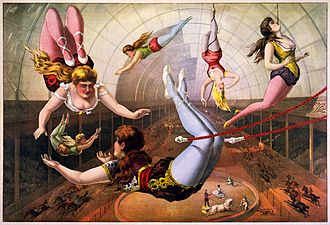
The sailing sense is unrelated in origin to the circus apparatus, but named for the analogous body position.
-
a gymnastic or acrobatic apparatus made of a short horizontal bar hung from two ropes
The performer swung gracefully from the trapeze.
-
(sailing) a wire and harness that lets a crew member lean far out over the side of a boat to counterbalance it
She hooked into the trapeze and leaned out as the boat heeled.
skiff

stiff [family]
"Stiff drink" = a strong alcoholic drink. "Stiff upper lip": traditional British emotional restraint. Informal: "a stiff" can also mean a corpse.
-
not easily bent
The cardboard is stiff.
-
sore from exercise or overuse
My neck is stiff today.
-
(sailing, of a boat) resistant to heeling; stable
The heavy keel makes the boat quite stiff in strong wind.
Both literal ("his body stiffened") and figurative ("resistance stiffened").
-
to make or become stiff
Her muscles stiffened after the run.
-
the quality of being stiff, physically or figuratively
She woke up with stiffness in her lower back.
loft [family]
In American English, "loft" often refers to converted industrial space used as residential/artistic space - popularized by SoHo in NYC.
-
a room or space directly under the roof of a house
They converted the loft into a bedroom.
-
(sailing) a workshop, traditionally on an open upper floor, where sails are made or repaired
The sailmaker brought the torn genoa to the loft for repair.
Lofty can praise ambitious ideals, but it can also criticize goals as unrealistic or a person as condescending.
-
very high or tall
The cathedral has a lofty vaulted ceiling.
-
showing high ideals or a grand but sometimes impractical ambition
The plan has lofty aims but few details about implementation.
-
arrogantly superior or distant in manner
His lofty tone annoyed the staff.
Grand Prix
French for "great prize". Plural: Grands Prix or Grand Prixs. Best known for Formula One races (e.g. "the Monaco Grand Prix").
-
any of several major international motor-racing or motorcycle-racing events
Thousands of fans lined the streets for the Monaco Grand Prix.
resurge / resurgence / resurgent [family]
-
to rise or become active again after a period of decline
Interest in the topic resurged after the documentary aired.
-
an increase or revival after a period of little activity, popularity, or occurrence
A resurgence of interest in religion.
-
becoming strong or popular again
A resurgent opposition won several seats.
handicap [family]
"Handicapped" (as a term for people with disabilities) is now considered outdated/offensive; "disabled" or "a person with a disability" is preferred. In golf, handicap is a numerical measure of a player's ability.
-
a circumstance that limits a person's ability
His shyness was a handicap in his career.
-
(in golf) a numerical measure that allows players of different abilities to compete fairly
He has a handicap of 12.
Now widely considered offensive when applied to people. Preferred: "disabled" or "a person with a disability". Still used in some neutral contexts: "handicapped parking".
-
(dated) having a disability
There are handicapped parking spaces near the entrance.
shore [family]
"Jersey Shore": MTV reality show. "Shore up" = strengthen (verb sense). Different from "coast" (broader region): shore is the immediate edge.
-
the land along the edge of a body of water
They walked along the shore.
-
situated or occurring on land
Onshore oil production.
-
towards or on the land, from the sea
The wind was blowing onshore.
-
the line along which a large body of water meets the land
The rugged coastline and shoreline.
"Offshore accounts" = bank accounts in foreign jurisdictions, often for tax avoidance.
-
located at sea, some distance from the shore
There is an offshore oil rig in the area.
-
based or operated abroad, especially to reduce taxes
The company moved its assets to an offshore account.
-
away from the shore; out at sea
They sailed five miles offshore.
Distinct from outsourcing (any contracting out). Classic example: US manufacturing moving to China; tech support to India. Politically charged topic.
-
moving business operations to another country
Offshoring of manufacturing cost many local jobs.
-
situated or occurring close to the shore
Inshore fishing requires only a small boat.
-
toward or near the shore
The current pulled the raft inshore.
coastline vs. shoreline
Both describe where water meets land, but coastline refers only to the sea and to the large-scale outline of a coast, while shoreline works for any body of water and points to the immediate, local water's edge.
- coastline
- The outline of a sea coast seen on a large scale, such as a region's or country's whole coast. It stresses overall shape and extent and applies only to oceans and seas.
- shoreline
- The line where water meets land at a specific place. It works for any body of water (sea, lake, or river), feels more local and immediate, and can shift with the tide.
- Use coastline only for the sea, especially for the large-scale shape of a coast.
- Use shoreline for the immediate water's edge, and for lakes and rivers as well as the sea.
- The tide moves the shoreline (the current water's edge) but not the coastline (the fixed outline).
prosper [family]
"Live long and prosper": Spock's signature line in Star Trek.
-
to succeed or flourish, especially financially
The business prospered under new management.
-
the state of being successful, especially financially
The country enjoyed decades of prosperity.
-
successful in material terms; flourishing financially
It was once a prosperous trading town.
lever / leverage [family]
-
a handle or bar used to move or control something
Pull the lever to open the gate.
-
to move or force something with a lever
They levered the stone out of the path.
-
the power to influence people or achieve results, especially by using resources effectively
The union used its leverage to negotiate better terms.
-
to use something to maximum advantage
The company leveraged its brand recognition to enter new markets.
upright [family]
-
in a vertical position; sitting or standing straight
Please return your seat to the upright position.
-
(of a person) honest, moral, and respectable
He's an upright citizen who serves on the school board.
-
a vertical post or beam
The fence is held up by metal uprights.
-
a piano with vertical strings and a tall, rectangular body, smaller than a grand piano
Most homes that have a piano have an upright piano rather than a grand.
ballast

lateral / bilateral [family]
-
relating to the side; moving sideways
The athlete worked on lateral movement.
-
involving two sides, groups, or countries
The two countries signed a bilateral agreement.
-
involving three or more sides, groups, or countries
The summit produced a multilateral treaty.
retract / retraction [family]
Two senses: pull back (claws, landing gear) or withdraw (statement). "Retraction": newspaper correction.
-
to pull back or draw in
The cat retracted its claws.
-
to withdraw a previous statement, offer, or claim
He refused to retract his comments.
"Retractable roof": common in modern stadiums (Wimbledon Centre Court since 2009). "Retractable leash": extending dog leash.
-
able to be pulled back
The stadium has a retractable roof.
-
a public statement withdrawing an earlier claim or statement
The newspaper printed a retraction the next day.
fin

Homophone with "Finn". "Shark fin soup" is controversial because of the cruel practice of finning (cutting fins off live sharks).
-
a thin flat part projecting from the body of a fish, used for swimming and balance
The dorsal fin sliced through the water.
apparent [family]
"Heir apparent": confirmed next-in-line. "Apparent" sometimes implies seeming-but-not-real ("apparent contradiction").
-
clearly visible or understood
It was apparent that he was lying.
-
perceived or seeming to be true based on observation, as distinct from the actual or true value
Apparent wind is the wind a sailor feels while moving, a combination of the true wind and the boat's own motion.
Often used to introduce information of uncertain reliability: implies "so I'm told" or "as it seems".
-
as far as one knows; seemingly
Apparently, she's moving to Paris.
keel [family]

"Keel over" (verb) = to fall over suddenly or collapse. "On an even keel" = in a stable, balanced state.
-
the main structural beam running along the bottom of a boat's hull, providing stability
The keel was damaged when the boat ran aground.
-
a sailboat with a fixed keel and ballast for stability, as opposed to a dinghy
The sailing club's keelboats are used for weekend races.
trim
Past tense: trimmed. Common: trim a hedge, trim hair, trim the fat from a budget.
-
to make neat by cutting away unwanted parts
She trimmed the hedge.
-
(sailing) to adjust the sails to make the best use of the wind
They trimmed the mainsail as the wind shifted.
"Trim and fit": a common collocation in fitness contexts.
-
slim and fit
He stays trim by running every day.
yacht

Pronounced "yot": notoriously tricky spelling. From Dutch jacht (hunt; chasing ship). Modern megayachts owned by billionaires can cost hundreds of millions.
-
a medium-sized sailing or motor boat used for pleasure cruising or racing
They sailed their yacht around the Mediterranean.
marine [family]

"Marine biology": study of ocean life. Capitalized "the Marines" = a military force, especially the US Marine Corps.
-
relating to the sea
He studies marine life.
More literary than "sailor". Famous: Coleridge's "The Rime of the Ancient Mariner" (1798). NASA's Mariner space probes explored Mars and Venus.
-
a sailor
The mariner navigated by the stars.
-
a specially designed harbor with moorings for pleasure yachts and small boats
They moored their yacht at the marina.
genoa

Named after the Italian city of Genoa, where the design originated. A large jib that overlaps the mainsail, especially used for racing.
-
a large jib that overlaps the mainsail, used especially in racing
They switched to a genoa for the light-wind leg of the race.
jib

"The cut of someone's jib": their general appearance or manner, from judging a ship's nationality by its jib sail's shape. A genoa is a large, overlapping type of jib.
-
a triangular sail set forward of the mast, ahead of the mainsail
They raised the jib as the wind picked up.
heel [family]
Body part: back of foot. "Achilles' heel": vulnerability.
-
the back part of the foot
She walked on her heels.
Shoe: "high heels". "Heel": also a wrestling term for villain.
-
the raised back part of a shoe
Her heels clicked on the floor.
-
wealthy
Well-heeled customers.
Distinct M-W homograph from the shoe/body-part senses. Related concept: capsize is the extreme, unwanted version of heeling.
-
(of a boat) to lean temporarily to one side, as from the force of wind or waves
The sailboat heeled sharply as the gust hit.
capsize
-
to overturn in water
The small boat capsized in the storm.
voyage
More literary/dramatic than "trip" or "journey". "Maiden voyage": a ship's first journey. "Voyager": NASA spacecraft (still operating after 1977 launch).
-
a long journey, especially by ship or in space
He recounted his voyage across the Atlantic.
circumnavigate [family]
-
to sail or travel all the way around something, especially the world
Magellan's crew was the first to circumnavigate the globe.
-
a journey all the way around something, especially a sailing voyage around the world
The circumnavigation took the small crew almost a year.
aboard
Also used as a preposition without "on": "aboard the ship", not "aboard of the ship".
-
on or into a ship, aircraft, train, or other vehicle
All passengers were asked to come aboard.
ensue [family]
-
to happen or occur afterwards or as a result
An argument ensued.
-
following immediately afterward or occurring as a consequence
The announcement and the ensuing selloff erased billions of dollars in market value.
canoe [family]

From Carib (indigenous Caribbean) word. Distinct from kayak: canoes are open and use single-bladed paddles; kayaks are closed with double-bladed paddles.
-
a narrow boat propelled with paddles
They paddled the canoe down the river.
-
the sport or activity of paddling a light, narrow boat
We went canoeing on the lake.
athlete [family]
"Athlete's foot": fungal infection of the foot. "Student-athlete": common American term (sometimes criticized for hiding profit motives in college sports).
-
a person who is proficient in sports
He's a world-class athlete.
"Athletic build": muscular and fit. "Athletic wear" / "activewear": modern category of stylish workout clothes.
-
physically fit and active
She has an athletic build.
British: "athletics" specifically refers to track and field. American: more general, covers all organized sports.
-
the practice of sports requiring physical strength and skill
He's a fan of college athletics.