Vocabulary: kitchen tool

20 entries

#8652

peel [family]

peeler
peeler
peeler /ˈpiːlɚ/ countable noun kitchen tool

"Vegetable peeler": kitchen tool. Old British slang "peeler" = police officer (named after Sir Robert Peel).

  • a tool for removing the skin of fruit or vegetables

    She used a peeler on the potatoes.

peel vs. skin

Both mean the outer covering of a fruit or vegetable, but usage and thickness differ - and only one is also a verb.

peel
Favored for thicker, firmer rinds you remove in pieces - orange peel, lemon peel, potato peel. 'Peel' is also the verb: to strip that covering off.
skin
Favored for the thin covering of softer fruit, especially while it is still on - apple skin, grape skin, tomato skin. 'Skin' is also the body's outer covering.
  • Rough guide: thick/removed -> peel; thin/attached -> skin.
  • Citrus 'zest' is just the colored outer part of the peel, grated off.
#8627

forceps / tongs [group]

tongs
tongs
tongs /tɔːŋz/ plural noun kitchen tool

Always plural: like scissors and pants. "A pair of tongs". Kitchen tongs, fireplace tongs, salad tongs.

  • a tool with two arms for gripping

    She turned the meat with tongs.

#7683

strain [family]

strainer
strainer
strainer /ˈstreɪnɚ/ countable noun kitchen tool

"Tea strainer": catches loose tea. "Colander": larger mesh strainer for pasta. Verb: strain (separate liquid from solids).

  • a device with holes for separating liquids

    She poured the pasta through the strainer.

sieve vs. strainer

Both are mesh kitchen tools, but a sieve is built for sifting dry ingredients or separating particles by size, while a strainer is built for draining liquid away from solids.

sieve
A flat or bowl-shaped mesh tool used to sift dry ingredients (like flour or powdered sugar) or separate coarser particles from finer ones; often has a fine, uniform mesh.
strainer
A mesh tool, usually with a handle, used to drain liquid away from solids - straining pasta water, catching loose tea leaves, or removing seeds from juice.
  • In casual kitchen speech the two words are often used interchangeably, since many tools can do both jobs.
  • If dry ingredients are being sifted, sieve is the more precise word; if liquid is being drained off, strainer is.
#7682

sieve

sieve
sieve
sieve /sɪv/ countable noun kitchen tool
  • a utensil consisting of a wire or plastic mesh held in a frame, used for straining solids from liquids or separating coarser from finer particles

    Pass the flour through a sieve to remove lumps.

sieve vs. strainer

Both are mesh kitchen tools, but a sieve is built for sifting dry ingredients or separating particles by size, while a strainer is built for draining liquid away from solids.

sieve
A flat or bowl-shaped mesh tool used to sift dry ingredients (like flour or powdered sugar) or separate coarser particles from finer ones; often has a fine, uniform mesh.
strainer
A mesh tool, usually with a handle, used to drain liquid away from solids - straining pasta water, catching loose tea leaves, or removing seeds from juice.
  • In casual kitchen speech the two words are often used interchangeably, since many tools can do both jobs.
  • If dry ingredients are being sifted, sieve is the more precise word; if liquid is being drained off, strainer is.
#7681

ladle

ladle
ladle
ladle /ˈleɪdəl/ countable noun kitchen tool

"Ladle": also a verb. "Big Dipper", constellation shaped like a ladle (alternative name in UK: "the Plough").

  • a deep long-handled spoon

    She used a ladle to serve the soup.

spoon vs. ladle

Both are handled utensils for moving liquid or food, but a ladle is a specialized, much larger tool built specifically for serving from a pot, while a spoon is the general-purpose everyday utensil.

spoon
The general, everyday utensil for eating, stirring, or serving - small enough to fit in your mouth.
ladle
A deep, long-handled, oversized spoon built specifically for scooping and serving liquids like soup or stew straight from a pot - never used for eating directly.
  • A ladle is really just a specialized kind of spoon, but its size and single purpose (serving liquid from a pot) earned it its own name.
  • You eat with a spoon; you serve with a ladle.
#7680

spoon

spoon
spoon
spoon /spuːn/ countable noun kitchen tool

"Born with a silver spoon in one's mouth" - born into wealth.

  • a utensil with a shallow bowl-shaped end and a handle, used for eating, stirring, or serving

    She stirred her coffee with a spoon.

spoon vs. ladle

Both are handled utensils for moving liquid or food, but a ladle is a specialized, much larger tool built specifically for serving from a pot, while a spoon is the general-purpose everyday utensil.

spoon
The general, everyday utensil for eating, stirring, or serving - small enough to fit in your mouth.
ladle
A deep, long-handled, oversized spoon built specifically for scooping and serving liquids like soup or stew straight from a pot - never used for eating directly.
  • A ladle is really just a specialized kind of spoon, but its size and single purpose (serving liquid from a pot) earned it its own name.
  • You eat with a spoon; you serve with a ladle.
#7526

rice cooker

rice cooker
rice cooker
rice cooker /ˈraɪs ˌkʊkɚ/ countable noun kitchen tool
  • an electric appliance that cooks rice automatically by steaming or boiling

    Just add water and rice, and the rice cooker does the rest.

#7525

pan [family]

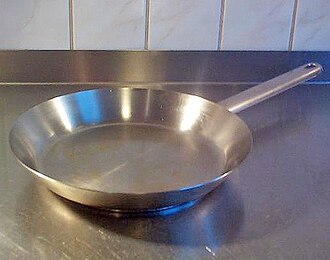
frying pan
frying pan
pan /pæn/ countable noun kitchen tool
  • a metal container, often with a long handle, used for cooking

    She heated the oil in a frying pan.

frying pan /ˈfraɪɪŋ ˌpæn/ countable noun kitchen tool
  • a shallow pan with sloping sides, used for frying food

    She fried the eggs in a frying pan.

#7524

wok

wok
wok
wok /wɑːk/ countable noun kitchen tool

Originated in Chinese cuisine; its curved shape allows for fast, high-heat stir-frying.

  • a large bowl-shaped pan used especially for stir-frying

    She tossed the vegetables in a sizzling wok.

#7523

chopping board / cutting board [group]

cutting board
cutting board
chopping board /ˈtʃɑːpɪŋ bɔːrd/ countable noun kitchen tool

Common in British English; American English usually says cutting board.

  • a flat board used as a surface for cutting food

    Put the onions on the chopping board.

cutting board /ˈkʌtɪŋ bɔːrd/ countable noun kitchen tool

Common in American English; British English often says chopping board.

  • a flat board used as a surface for cutting food

    Use a separate cutting board for raw chicken.

#7522

kettle [family]

kettle
kettle
kettle /ˈketəl/ countable noun kitchen tool

"Pot calling the kettle black": hypocritical criticism. "Kettle" is much more common in British English (for tea). "Put the kettle on": make tea.

  • a metal or plastic container for boiling water

    She put the kettle on for tea.

teakettle /ˈtiːketəl/ countable noun kitchen tool

American term, since the British just say "kettle". "Whistling teakettle": has a whistle that sounds when water boils.

  • a kettle for boiling water for tea

    The teakettle whistled when the water boiled.

#7521

range hood

range hood
range hood
range hood /ˈreɪndʒ ˌhʊd/ countable noun kitchen tool

Also called an 'extractor hood' (UK) or 'exhaust hood'.

  • a ventilation device above a stove that removes smoke, steam, and odors

    Turn on the range hood before you start frying.

#7520

microwave oven

microwave oven
microwave oven
microwave oven /ˈmaɪkroʊweɪv ˌʌvən/ countable noun kitchen tool

Usually just called a 'microwave' in everyday speech.

  • a kitchen appliance that cooks or heats food quickly using electromagnetic waves

    He heated the leftovers in the microwave oven.

#7489

whisk

whisk
whisk
whisk /wɪsk/ countable noun kitchen tool

Types: balloon whisk, flat whisk, French whisk. "Whisk" (verb), also to remove quickly: "she was whisked away in a limo".

  • a kitchen utensil for beating eggs or cream

    He used a whisk to beat the eggs.

#7416

tray

tray
tray
tray /treɪ/ countable noun kitchen tool

"Serving tray", "baking tray", "ice cube tray". In email/computing: "inbox tray". "Tray table": fold-down table on airplane seats.

  • a flat shallow container with raised edges, used for carrying things

    The waiter carried a tray of drinks.

#7389

stopper

stopper
stopper
stopper /ˈstɑːpɚ/ countable noun kitchen tool

"Conversation stopper" - figurative use for a remark that ends discussion.

  • a plug used to close an opening, such as the top of a bottle

    She pushed the cork stopper back into the bottle.

#7371

spatula

spatula
spatula
spatula /ˈspætʃələ/ countable noun kitchen tool

"Spatula", wide range: rubber for mixing, metal for flipping pancakes, silicone for scraping bowls. UK: "fish slice" = flat spatula for flipping.

  • a flat-bladed kitchen tool

    She flipped the pancake with a spatula.

#7370

funnel

funnel
funnel
funnel /ˈfʌnəl/ countable noun kitchen tool

"Sales funnel" in marketing = the path customers follow from awareness to purchase.

  • a tube or pipe wide at the top and narrow at the bottom, used for pouring liquids or powders into a small opening

    She used a funnel to pour the oil into the bottle.

#7368

flatware / cutlery [group]

flatware
flatware
flatware /ˈflætwer/ uncountable noun kitchen tool

American term. UK preference: "cutlery". Often used in restaurant/catering contexts in the US. Includes forks, knives, spoons.

  • (US) eating utensils

    They polished the silver flatware.

cutlery /ˈkʌtlɚi/ uncountable noun kitchen tool

British term. From "cutler" (knife-maker). "Cutlery drawer": common storage. Includes the same items as flatware.

  • (UK) eating utensils

    Please set out the cutlery.

cutlery vs. utensil

Cutlery (or flatware) refers specifically to the forks, knives, and spoons used for eating, while utensil is a much broader word covering any hand tool used in food preparation or eating.

cutlery
The British term (American: flatware) for the set of forks, knives, and spoons used at the table for eating.
utensil
A broad term for any hand tool used in the kitchen or at the table, including cutlery but also things like spatulas, whisks, and ladles.
  • All cutlery items are utensils, but not all utensils are cutlery.
  • In everyday speech, "utensils" often implies cooking tools, while "cutlery"/"flatware" implies eating tools.
#5880

apron

apron
apron
apron /ˈeɪprən/ countable noun kitchen tool

"Tied to her apron strings" = an old-fashioned phrase for being overly dependent on one's mother.

  • a garment worn over the front of one's clothes to keep them clean while cooking or working

    She put on her apron before kneading the dough.